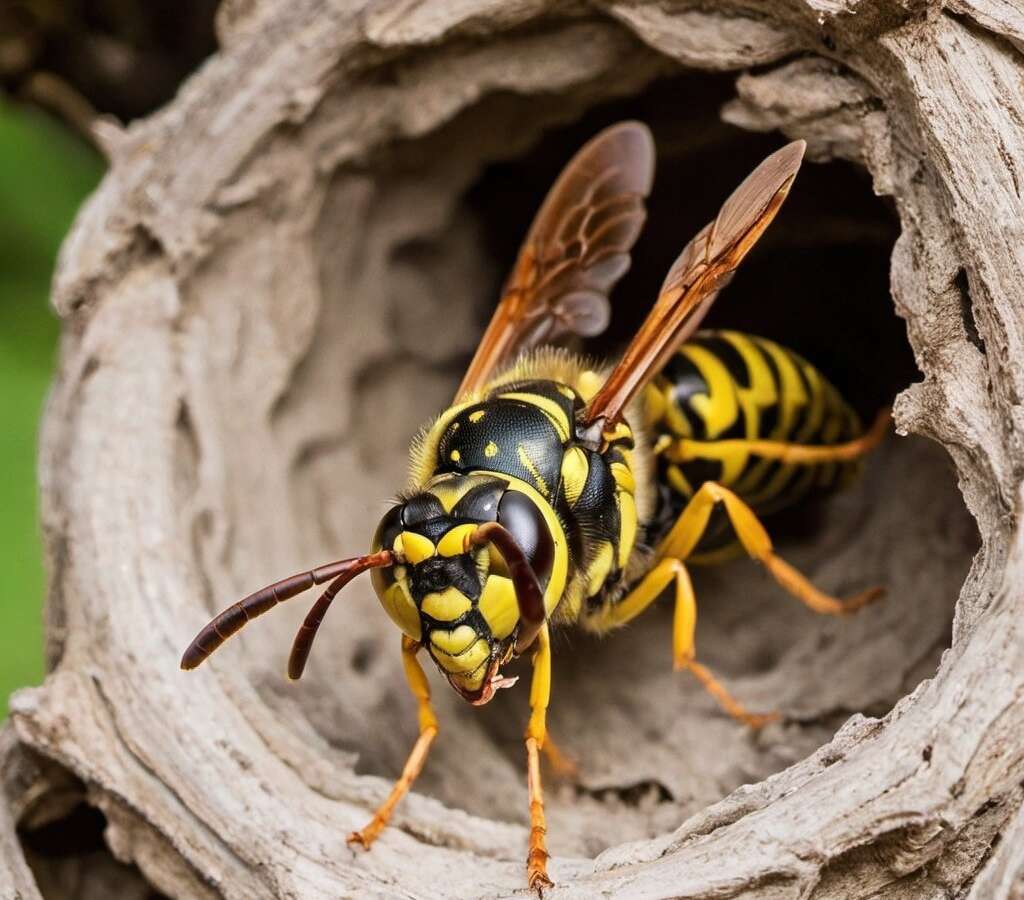

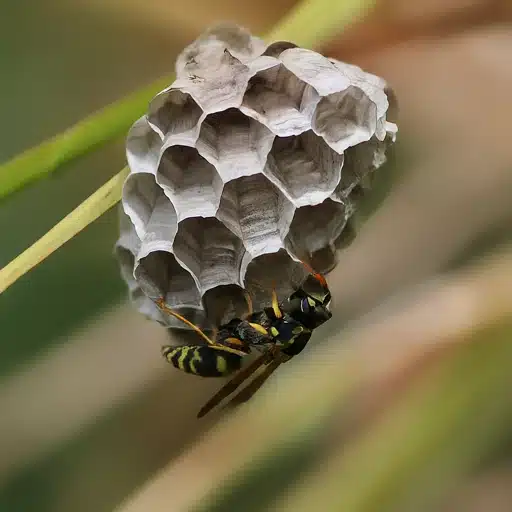

During the summer months, we love to spend time outdoors. One of the issues with being outdoors, though, is that you’re sharing the ecosystem with insects such as wasps. Wasps are stinging insects, and their stings can be painful and potentially dangerous, especially for someone who has a severe allergy. If you think you’re having a problem with wasps, it’s important to contact a Broken Arrow Exterminator who can help. Let’s take a look at wasps and how they operate.
Wasps can generally be described as either solitary or social. Paper wasps are a familiar example of social wasps. Their colonies build nests containing multiple cells, and developing young are raised within those cells. Solitary wasps, including mud daubers, do not form the large cooperative colonies associated with social wasps. A female mud dauber typically constructs a nest containing multiple individual brood cells rather than a single-cell nest.
Adult wasps commonly obtain energy from nectar and other sugary foods. Many species also hunt other arthropods to provide food for their developing larvae. Mud daubers, for example, commonly capture and paralyze spiders with their stingers, place the prey inside a brood cell, lay an egg, and seal the cell. When the egg hatches, the larva feeds on the stored prey and develops inside the protected cell before eventually emerging as an adult.
Wasps also play an important role in the ecosystem. Many species are predators that help control populations of insects and spiders. That means a wasp seen away from a structure is not automatically a pest problem. The situation changes when a nest is located where people regularly walk, work, play, or enter a building.
Social and solitary wasps can create very different pest-control situations. Social species may have many individuals associated with a nest and can defend the colony when they perceive a threat. Solitary species generally do not defend their nests as aggressively, although individual wasps can still sting. Oklahoma State University Extension provides information about wasps, bees, nesting behavior, and stinging-insect management.
Depending on the species, wasp nests may be found beneath rooflines, under decks, around sheds, in wall voids, in trees or shrubs, on playground equipment, or in the ground. Correct identification matters because different species have different nesting habits and levels of defensiveness. Before trying to remove an active nest, especially one in a difficult location, it is important to understand what type of stinging insect is present.
Wasps can strongly defend nests when they feel threatened. This is where your Broken Arrow Exterminator comes in. A nest around a porch, doorway, playset, deck, or other high-traffic area can increase the chance that someone will accidentally disturb it and be stung. People with known severe sting allergies should be especially cautious around active nests. CDC guidance notes that insect stings can cause severe allergic reactions in some people.
A Broken Arrow Exterminator can inspect the area, identify the stinging insect, determine where the nest is located, and choose an appropriate control method. TermMax Pest Control can help with wasps and other pest-control problems. Contact us today for affordable solutions.